


Sim&Train: Medical training that mirrors the reality of the interventional suite
Sim&Train: Medical training that mirrors the reality of the interventional suite
In interventional neuroradiology, precision is critical. Physicians must develop the technical skills, confidence, and decision-making abilities required to perform procedures. These capabilities are built through repeated, hands-on practice.
Sim&Cure developed Sim&Train to help address this need. The solution enables physicians to practise endovascular procedures in a safe and immersive environment that closely reflects real clinical conditions. By combining replicated vascular anatomies with real implant devices, Sim&Train allows users to observe implantable device behaviour, understand anatomical challenges, and refine their techniques through hands-on practice.
Since its launch in 2023, Sim&Train has been used in more than 3,000 training sessions. Our solution supports training for both haemorrhagic and ischaemic stroke procedures, helping physicians gain experience and build confidence before entering the interventional suite.
From day one, the goal has been clear: make high-quality, realistic training more accessible to hospitals and implantable medical device manufacturers.
How does Sim&Train work?
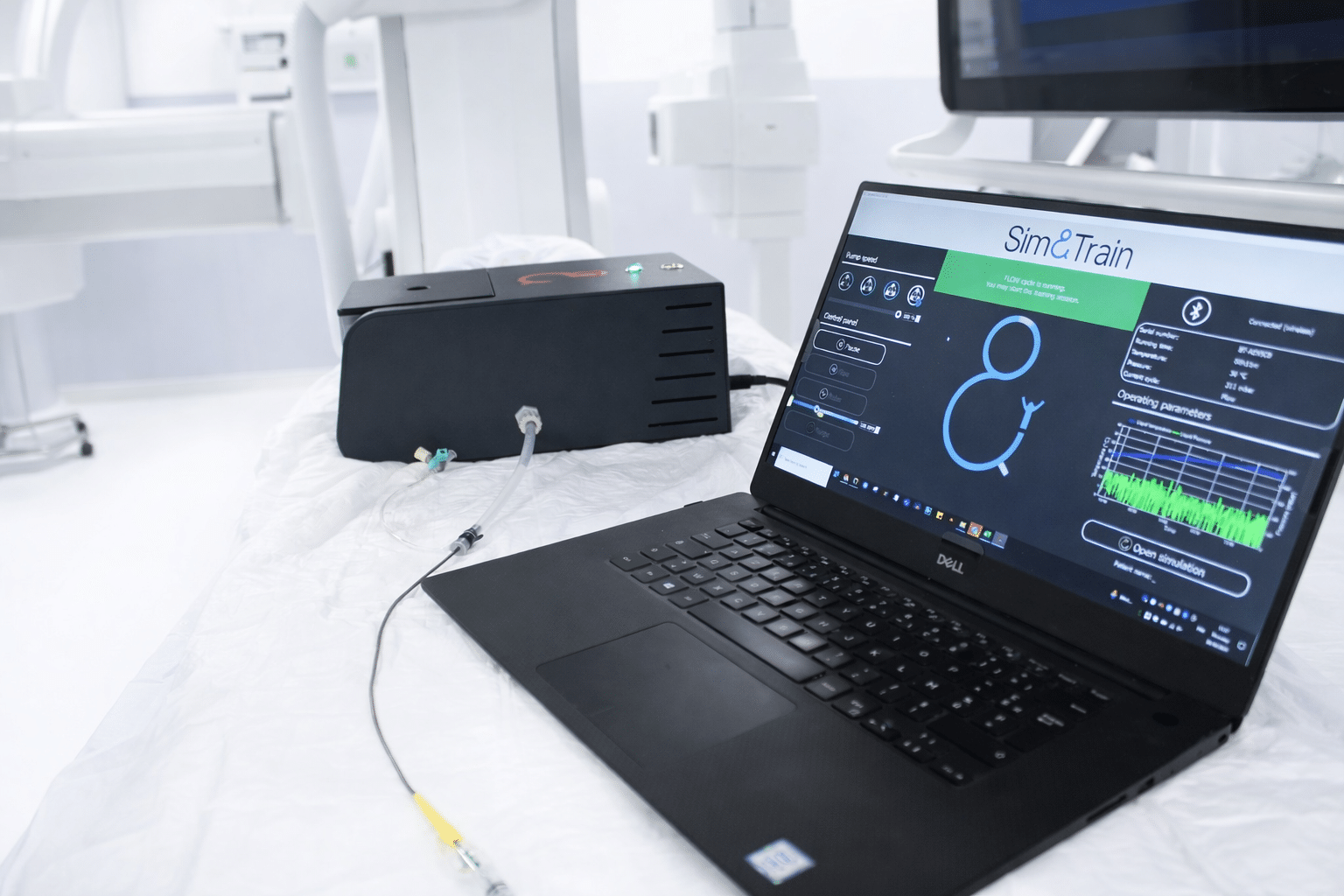
At the heart of Sim&Train is the B-Train station, a compact plug-and-play system designed to emulate blood flow and vascular conditions.
Because it is portable and easy to set up, the station can be used directly in a CathLab under X-ray guidance or on a tabletop for hands-on procedural training.
B-Train circulates water at body temperature through transparent vascular models to simulate blood flow in the brain’s blood vessels. These models are created from real anatomical data, which allows practitioners to train on a wide range of clinical scenarios.
A 3D-printed aortic arch can also be added to simulate vascular access and make training sessions closer to reality.
What makes Sim&Train different?
Sim&Train brings together three core capabilities into a single training solution.
- Realistic procedural training: reproduce hemodynamic conditions, patient-derived anatomical models, and direct visibility into implant device deployment, for training that reflects clinical reality.
- Plug-and-play setup: easy to set up in less than 5 minutes, enabling rapid deployment in a wide range of clinical environments.
- Fully adaptable training scenarios: cartridges and parameters are fully customizable by implant device type, pathology, and skill level, including for the latest generation of implants.
Continuously shaped by clinical feedback
Since its launch, Sim&Train has evolved through several versions. Each update has been shaped by feedback from clinicians and training teams, leading to greater realism, improved ergonomics, and a broader range of clinical scenarios.
Developed and designed entirely in-house by Sim&Cure, the solution benefits from rigorous quality control and an agile development process. This enables the rapid creation of new anatomical models and the continuous refinement of the system to address the evolving needs of healthcare professionals.
Connecting digital planning with hands-on practice
Sim&Train can be complemented by Sim&Size Education, a digital platform that allows users to assess different implant deployment strategies using 3D anatomical reconstructions reproduced on silicone models. Together, these technologies are designed to support the elaboration of treatment strategies tailored to cartridges, whether custom or catalog-based.
Together, the two solutions connect digital simulation with physical practice. Clinicians can discuss procedural strategies, test them with real implantable medical devices, and observe device behavior in an anatomical model that closely reflects real vascular anatomies.
Supporting clinicians and implantable device manufacturers
For healthcare professionals, Sim&Train is a practical tool for building skill: repeating difficult gestures without any risk to patients, working through a variety of anatomies, developing a deeper understanding of how implants behave, and gaining confidence faster
For implantable medical device manufacturers, it is a way to scale and standardize product adoption, ensuring clinicians deploy their latest generation of implants with consistent proficiency, regardless of the environment.
Sim&Train is currently used by academic and clinical centers across Europe, including:
- Tor Vergata University, Italy
- Lille University Hospital, France
- Medisim at the University of Tours, France
What’s next for Sim&Train?
Making realistic training more accessible
Sim&Cure’s ambition is to make hands-on training a standard part of every physician’s learning journey.
The long-term goal is to support training centers, scientific societies, and hospitals with a realistic, practical, and accessible solution that can be integrated into a wide range of educational environments.
Aurélien SICOT, Product Marketing Manager
Advancing the technology
Over the coming months, Sim&Train development will focus on three priorities:
- Improving material properties and 3D printing techniques to better reproduce the mechanical behavior of blood vessels and arteries;
- Expanding the anatomical model library with more complex vascular geometries, including distal access and specific ischemic and hemorrhagic stroke cases;
- Developing B-Train, a streamlined flow model designed to halve the system’s weight and volume by consolidating electronics and integrating essential sensors, while remaining fully compatible with the Sim&Train software ecosystem.
Nicolas ANTOINE, Sim&Train Project Leader
Long-term vision
The neurovascular field is evolving at an unprecedented pace. New implant designs, increasingly complex treatment strategies, advanced imaging technologies and patient-specific planning tools are expanding what physicians can achieve. But they all share one common challenge: they only improve patient care if physicians can adopt them confidently and consistently.
At the same time, gaining experience through clinical exposure alone is becoming increasingly difficult. Procedural volumes vary between hospitals, unusual cases remain relatively rare by definition, and expectations for patient safety have never been higher. As technology becomes more sophisticated, clinicians need opportunities to practice beyond the clinical environment.
Simulation offers a way to resolve that paradox. As we like to point out, just as flight simulators became indispensable to aviation, procedural simulation is an essential complement to clinical training. It does not replace mentorship or real-world experience, but it accelerates learning. Beyond reproducing patient anatomies, our simulation technology enables clinicians to train with the same implants, accessories and imaging workstations they use in daily clinical practice. That level of procedural realism remains essential.
Our 3D-printed models can be imaged using the same clinical imaging systems employed in routine practice and linked to computational models that predict device behavior. Looking ahead, computational models and AI will make it possible to personalize training through realistic scenarios and objective performance assessment.
Training is becoming increasingly data-driven and personalized, and we are developing solutions to support this evolution. At Sim&Cure, we operate at the intersection of imaging, computational simulation and medical devices, helping connect these technologies into a more coherent learning environment for physicians. The validated digital twins of implants that support patient-specific treatment planning can also power physician education. Rather than developing separate solutions for planning and training, we see both as applications of a shared digital foundation.
I believe this is the direction in which our field is evolving. By connecting imaging, simulation, digital twins and procedural training, we believe advanced neurovascular expertise can become more accessible, more consistent and ultimately more beneficial for patients. This is the future we are helping shape.
Christophe CHNAFA, PhD, Chief Innovation and Strategy Officer
Conclusion
Sim&Train is built on a belief: effective training requires practice that feels realistic, remains safe, and reflects the challenges of clinical practice.
Guided by feedback from clinicians and training teams, the solution continues to evolve to support better preparation, deeper implant device understanding, and greater procedural confidence.
Whether helping healthcare professionals develop their skills or enabling implantable medical device manufacturers to deliver consistent, hands-on product training, Sim&Train is designed for the moments when preparation matters most.
Plan for performance, execute with confidence
Sim&Train is a training and demonstration platform intended for educational use only. It is not a medical device and is not intended to diagnose, treat, cure, or prevent any health condition.